
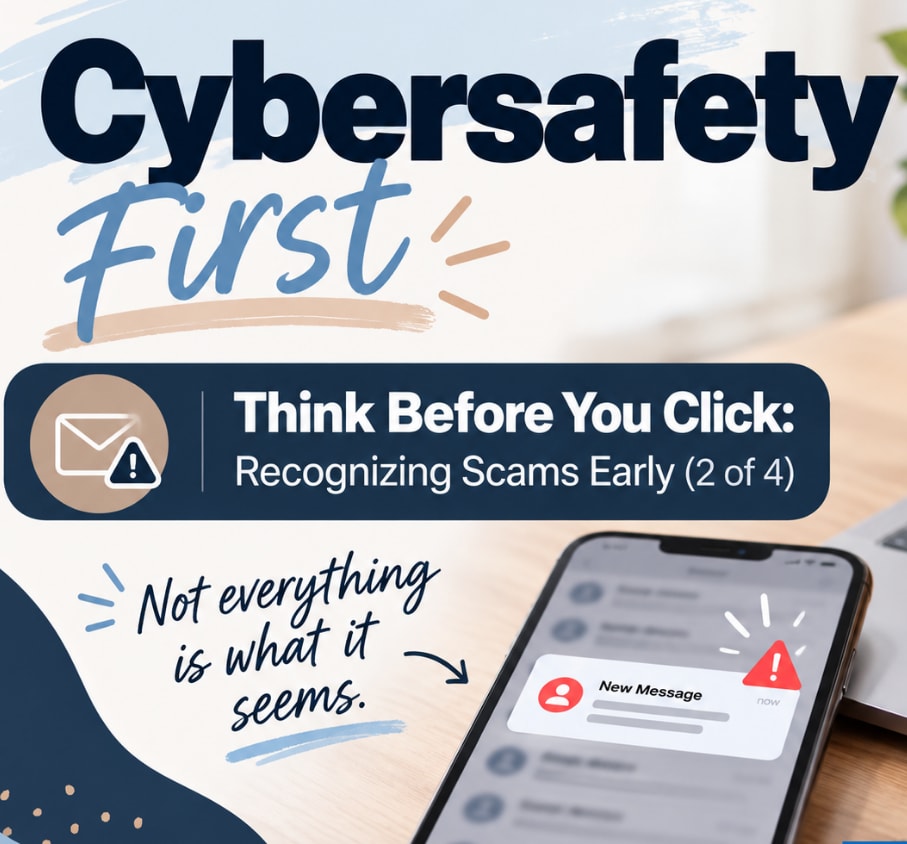
Cybersafety First
Think Before You Click: Recognizing Scams Early (2 of 4)

A message may look like it came from a title company.
A text might appear to be from a client.
A caller ID may display a familiar name.
But is it really them?
This October, one of the National Cybersecurity Alliance’s four key recommendations for Cybersecurity Awareness Month is to recognize and report scams.
That can be especially important in real estate, where cybercriminals may target transactions involving large sums of money and multiple parties communicating electronically.
Phishing remains one of the most common ways criminals attempt to steal passwords, gain access to accounts, or collect sensitive information. In the National Cybersecurity Alliance’s latest multiyear study of cybersecurity habits, phishing accounted for 40 percent of reported cyber incidents in 2025.
Fraudulent messages may ask you to click a link, open an attachment, enter a password, or provide personal or financial information. Similar scams can arrive through texts or phone calls.
And they’re getting more convincing.
 The National Association of REALTORS warns that scammers can spoof phone numbers, email addresses, and websites to make a communication appear legitimate. Artificial intelligence is also giving criminals new tools to create convincing messages, imitate voices, and impersonate people involved in a transaction.
So what should make you stop and take another look?
Be cautious when a message creates urgency. Watch for unexpected requests for passwords, financial information, or account access. Check email addresses carefully for small changes, such as an extra letter or slightly altered domain name.
And pay attention when something simply seems unusual.
If a longtime client suddenly communicates differently, or a trusted professional makes a request you weren’t expecting, verify it another way.
Don’t reply directly to the questionable message. Instead, contact the person using a phone number or communication method you already know to be legitimate.
Most important, slow down.
Cybercriminals often want you to act before you think.
A few extra seconds can sometimes prevent a costly mistake.
Our REALTOR members throughout Eastern Middle Tennessee depend on relationships and communication every day. Protecting those relationships now also means making sure the person on the other end of an email, text, or call really is who they claim to be.
Think before you click. Verify before you act. And when something doesn’t look right, check.
That’s smart cybersecurity—and smart business.
Click here for a menu of EMTAR Consumer Resources.
About EMTAR: Chartered in 1969, our Association’s 1,200+ REALTORS are a proud part of the 36,000+ members of Tennessee REALTORS and of the 1.5 million+ members of NAR, all working to serve the public and protect the rights of America’s property owners. EMTAR members are known not only for their unmatched real estate excellence and high ethical standards, but also for being generous, hospitable, others-focused, loyal, hardworking, and eager to help wherever and whenever help is needed.